Finding Your Path to Fluency


Language learning is not a one-size-fits-all journey. Over decades of research and practice, educators and polyglots have identified numerous approaches to acquiring a new language. Understanding these methods can help you choose the most effective path for your learning style, goals, and circumstances.
1. Immersion-Based Learning
The Method: Surrounding yourself with the target language in authentic contexts, forcing your brain to adapt and acquire the language naturally, similar to how children learn their first language.
How it works: Living in a country where the language is spoken, consuming native media, thinking in the target language, and using it for daily activities.
Strengths: Develops natural fluency, cultural understanding, and intuitive grammar sense.
Challenges: Requires significant time investment and often geographical relocation; can be overwhelming for beginners.
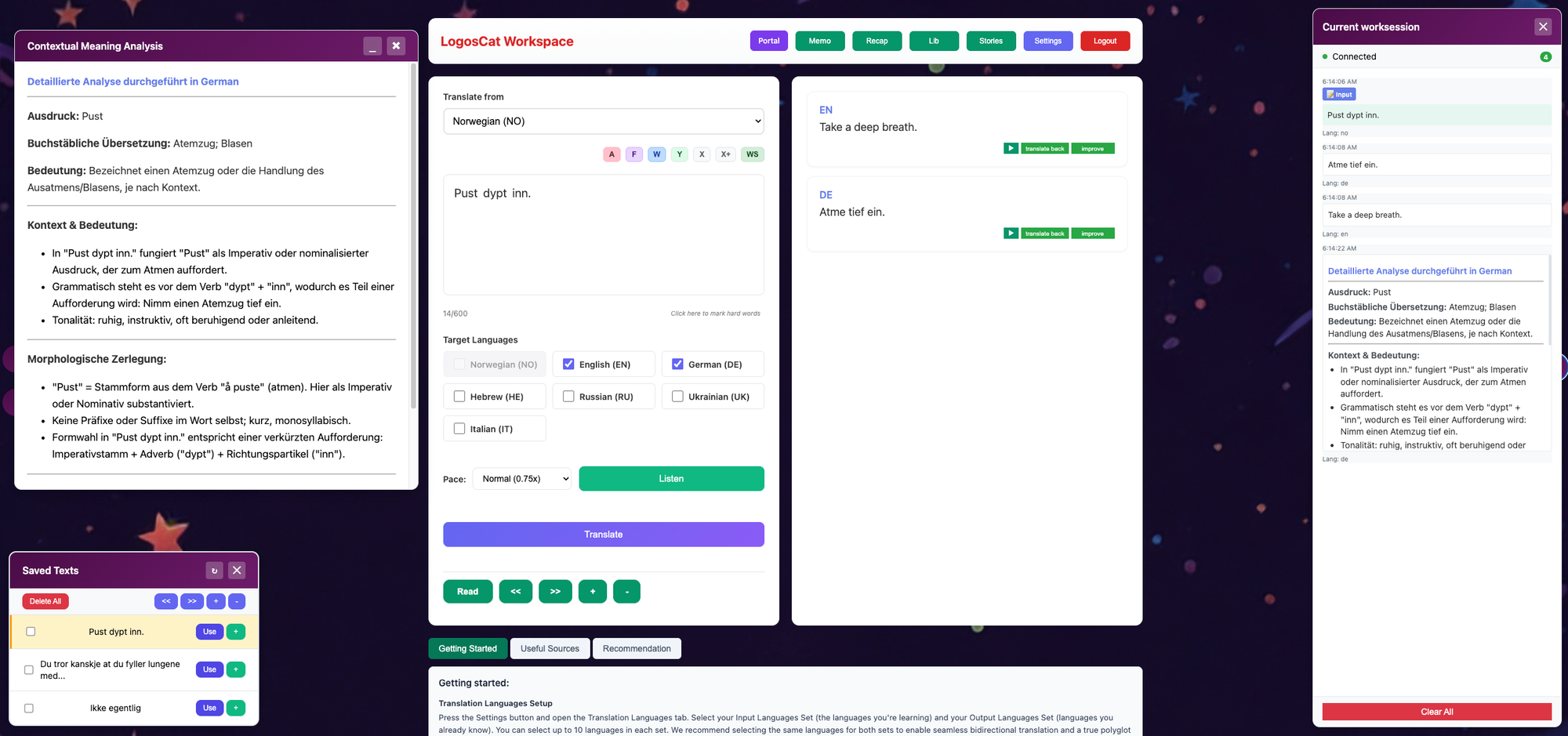
LogosCat enhances immersion by providing instant access to authentic content across 29 languages. Its text-to-speech capabilities let you hear native pronunciation patterns, while simultaneous multi-language translation helps you understand context without breaking immersion—perfect for reading articles, books, or social media in your target language while maintaining comprehension.
2. Grammar-Translation Method
The Method: The traditional academic approach focusing on explicit grammar rules, vocabulary memorization, and translating between your native language and the target language.
How it works: Systematic study of grammatical structures, extensive vocabulary lists, written translation exercises, and literary analysis.
Strengths: Builds strong reading comprehension and grammatical accuracy; excellent for understanding language structure.
Challenges: Often produces learners who can read and write but struggle with speaking and listening; can feel dry and disconnected from real communication.
3. Communicative Language Teaching (CLT)
The Method: Prioritizing meaningful communication over grammatical perfection, emphasizing interaction and real-world language use from day one.
How it works: Role-playing, information-gap activities, collaborative tasks, and conversation practice where the goal is successful communication rather than flawless grammar.
Strengths: Develops practical speaking skills quickly; builds confidence in real conversations.
Challenges: May neglect formal accuracy; requires access to conversation partners or teachers.
4. The Direct Method
The Method: Teaching exclusively in the target language without translation, using demonstrations, visual aids, and context to convey meaning.
How it works: Teachers demonstrate concepts through actions, pictures, and realia, avoiding any use of the learner's native language.
Strengths: Encourages thinking directly in the target language; develops strong listening skills.
Challenges: Can be confusing for abstract concepts; requires skilled instructors; slower progression for some learners.
5. Audio-Lingual Method
The Method: Heavy emphasis on repetition, pattern drills, and habit formation through intensive listening and speaking practice.
How it works: Dialogues are memorized through repetition, pattern drills reinforce structures, and errors are immediately corrected to prevent bad habits.
Strengths: Builds strong pronunciation and automatic responses; useful for developing speaking fluency.
Challenges: Can become monotonous; focuses on form over meaning; limited creativity in early stages.
6. Task-Based Language Learning (TBLL)
The Method: Learning language through completing meaningful tasks that require communication, where language is the tool rather than the objective.
How it works: Learners work on projects, solve problems, or complete activities that naturally require language use, with explicit language instruction coming after task completion.
Strengths: Highly motivating; develops practical skills; integrates all language skills naturally.
Challenges: Requires careful task design; can be chaotic without structure; needs appropriate task difficulty.
7. Content and Language Integrated Learning (CLIL)
The Method: Learning language through studying other subjects—history, science, art—taught in the target language.
How it works: Academic content is delivered in the target language, making language acquisition a byproduct of learning interesting material.
Strengths: Provides authentic motivation and context; builds academic vocabulary; kills two birds with one stone.
Challenges: Requires higher language proficiency; can be cognitively demanding; may compromise content understanding.
LogosCat's simultaneous translation across multiple languages makes CLIL accessible even for beginners. Read scientific articles, historical documents, or specialized content in your target language while having instant reference to your native language and even additional languages for deeper understanding. The etymological analysis feature helps you understand technical vocabulary by revealing roots and connections across languages.
8. Comprehensible Input (Natural Approach)
The Method: Based on Stephen Krashen's theories, this approach focuses on exposing learners to language that is just slightly above their current level (i+1), emphasizing understanding over production.
How it works: Extensive listening and reading at appropriate levels, with speaking emerging naturally when the learner is ready, not forced prematurely.
Strengths: Low-stress, natural progression; builds solid foundation before speaking; respects silent period.
Challenges: Requires vast amounts of appropriate-level material; passive approach may not suit all learners; speaking skills may lag.
LogosCat provides the perfect environment for comprehensible input across 29 languages. Select content at your level, gradually increase difficulty, and use the multi-language translation to maintain comprehension while challenging yourself. The platform's extensive content access gives you unlimited material at every proficiency level.
9. Total Physical Response (TPR)
The Method: Learning language through physical movement and action, particularly effective for beginners and young learners.
How it works: Instructors give commands in the target language, learners respond with actions, gradually building comprehension before production.
Strengths: Engaging and memorable; reduces anxiety; excellent for kinesthetic learners; effective for basic vocabulary.
Challenges: Limited to action-based vocabulary; difficult for abstract concepts; less effective at advanced levels.
10. Spaced Repetition Systems (SRS)
The Method: Using scientifically-optimized review intervals to maximize retention and minimize study time, typically through flashcard systems.
How it works: Items are reviewed at increasing intervals based on performance, with difficult items appearing more frequently and mastered items appearing rarely.
Strengths: Highly efficient for vocabulary retention; scientifically proven; scalable to large vocabularies.
Challenges: Can become mechanical; focuses primarily on recognition over production; requires consistent daily practice.
11. Language Exchange and Tandem Learning
The Method: Partnering with a native speaker of your target language who wants to learn your native language, creating mutually beneficial practice.
How it works: Structured conversations where each partner helps the other, typically alternating between languages or topics.
Strengths: Free or low-cost; cultural exchange; authentic conversation practice; builds genuine friendships.
Challenges: Requires finding compatible partners; can be imbalanced; may reinforce errors without expert guidance.
12. Polyglot Method
The Method: Leveraging similarities between languages, using known languages as bridges to new ones, and developing metalinguistic awareness.
How it works: Strategic learning of related languages in sequence, conscious analysis of linguistic patterns, and application of proven personal strategies.
Strengths: Accelerates learning of related languages; develops deep linguistic insight; highly personalized.
Challenges: Requires metalinguistic sophistication; risk of interference between similar languages; not applicable to first foreign language.
LogosCat is specifically designed for the polyglot approach with its simultaneous multi-language translation feature. See how words and concepts express across multiple languages at once, trace etymological connections, and build explicit awareness of linguistic patterns. The platform's support for 29 languages makes it ideal for exploring language families and understanding deeper structural relationships.
13. Reading Method (Extensive Reading)
The Method: Acquiring language primarily through massive amounts of reading, typically starting with graded readers and progressing to authentic texts.
How it works: Reading for pleasure and general understanding rather than detailed analysis, tolerating ambiguity, and acquiring vocabulary through context.
Strengths: Builds large passive vocabulary; improves reading speed; enjoyable and self-directed; exposure to natural language.
Challenges: Speaking and listening skills may lag; requires self-discipline; pronunciation development limited.
LogosCat transforms extensive reading by making any web content accessible across 29 languages. Read authentic material immediately, even as a beginner, with instant translation support. The text-to-speech function ensures you're also developing pronunciation and listening skills alongside your reading, addressing one of the traditional method's weaknesses.
14. Shadowing Technique
The Method: Listening to native speech and attempting to reproduce it simultaneously or with minimal delay, mimicking pronunciation, rhythm, and intonation.
How it works: Playing audio of native speakers and speaking along, trying to match every aspect of their speech, from individual sounds to emotional tone.
Strengths: Dramatically improves pronunciation and intonation; develops listening skills; builds speaking fluency and confidence.
Challenges: Requires quality audio materials; can be exhausting; difficult to maintain focus; needs progression to actual conversation.
LogosCat's text-to-speech capabilities across 29 languages provide unlimited shadowing material. Select any text—from news articles to literary passages—and practice shadowing with natural, high-quality pronunciation models. Switch between languages to develop multilingual fluency simultaneously.
15. Lexical Approach
The Method: Focusing on multi-word "chunks" or collocations rather than individual words and grammar rules in isolation.
How it works: Learning common phrases, idioms, and word combinations as whole units, recognizing that native fluency relies on stored phrases rather than purely generative grammar.
Strengths: Develops more native-like fluency; practical and efficient; reflects how language is actually used.
Challenges: Less systematic than grammar-focused approaches; requires extensive exposure to authentic material.
Choosing Your Path
The most effective language learners rarely commit to a single method. Instead, they combine approaches based on their goals, learning style, and current level. A beginner might start with comprehensible input and basic grammar study, add extensive reading and shadowing for pronunciation, eventually progressing to immersion and conversation practice.
The digital age has made eclectic approaches more accessible than ever. Modern learners can combine the structure of traditional methods with the authenticity of immersion, the efficiency of spaced repetition with the engagement of content-based learning.
Whatever path you choose, consistency, patience, and genuine engagement with the language and culture will ultimately determine your success. The best method is the one you'll actually use—day after day, week after week, until one day you realize you're no longer translating, but simply understanding.
Platforms like LogosCat represent the evolution of language learning technology, providing tools that support multiple methodologies simultaneously. Whether you prefer immersion-style reading, systematic vocabulary building, polyglot comparison, or content-based learning, having instant access to authentic materials across 29 languages with sophisticated translation and analysis features means you can design the perfect learning approach for your unique needs and goals.